The short answer
MTU means maximum transmission unit: the largest packet or frame a network link can carry without needing it to be split into smaller pieces at that layer. It matters because every link on a route has a limit. If a packet is too large for part of the journey, the connection may need to fragment it, reduce its size, or report an error.
On many Ethernet networks, 1500 bytes is a common IP MTU. It is not a universal internet setting. Mobile links, tunnels, VPNs, and the path to a particular destination can all have a different usable limit.
Link MTU and path MTU are different
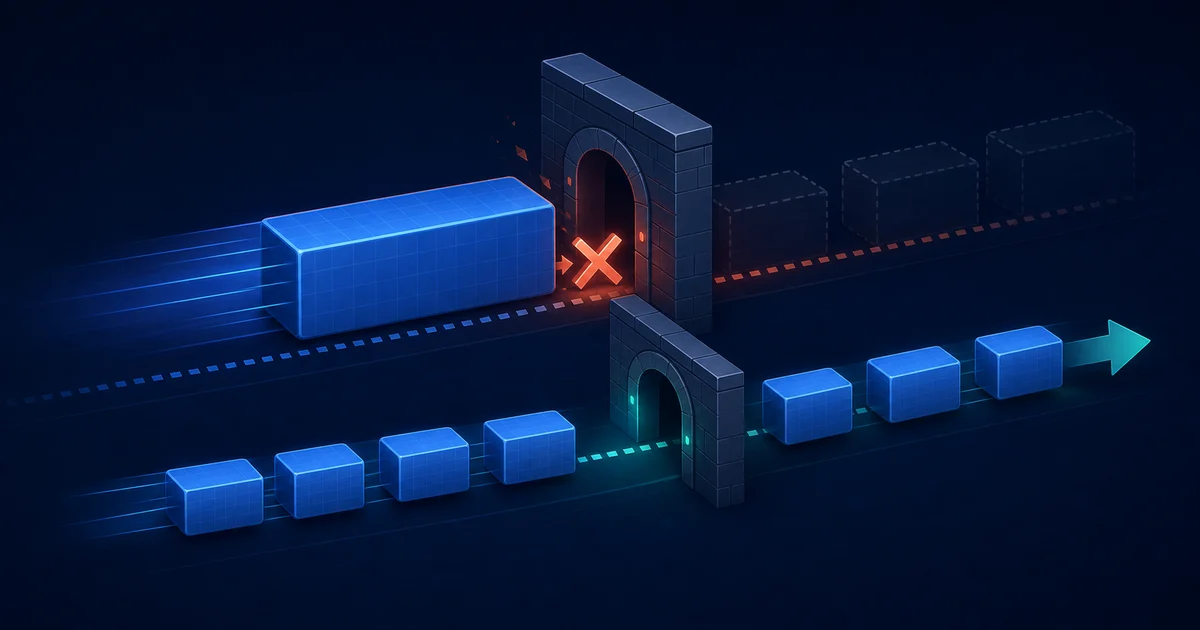
A link MTU is the limit on one connection, such as the link between a laptop and a router. A path MTU is the smallest relevant MTU on the full route between a sender and destination. A packet must fit through every link, so one smaller link can set the practical maximum.
Think of a delivery route that includes several doors. A box that fits through the first door still cannot reach the destination if it will not fit through a later one. The narrowest door determines the largest box that can complete the route.
Protocols also add headers. An application payload is only part of a packet; IP, TCP or UDP, and sometimes encryption or tunneling headers consume space too. That means an application cannot assume a 1500-byte payload fits just because a local interface reports an MTU of 1500.
What happens when a packet is too large?
IPv4 can allow fragmentation in some circumstances, where a large datagram is divided into fragments and reassembled later. Fragmentation has costs: losing one fragment can make the entire original datagram unusable, and fragments can be harder for networks to handle efficiently.
IPv6 takes a different approach. Routers do not fragment packets in transit. Instead, the sender should learn that it needs a smaller packet size and adjust. This makes correct Path MTU Discovery (PMTUD) important. An IPv6 router can send an ICMPv6 Packet Too Big message to report the problem.
When those control messages are filtered incorrectly, a connection may appear to start normally and then stall when it tries to send larger data. That is often called a path-MTU black hole. It is one possible cause of a site or VPN working partly but not reliably.
Why VPNs can change effective MTU
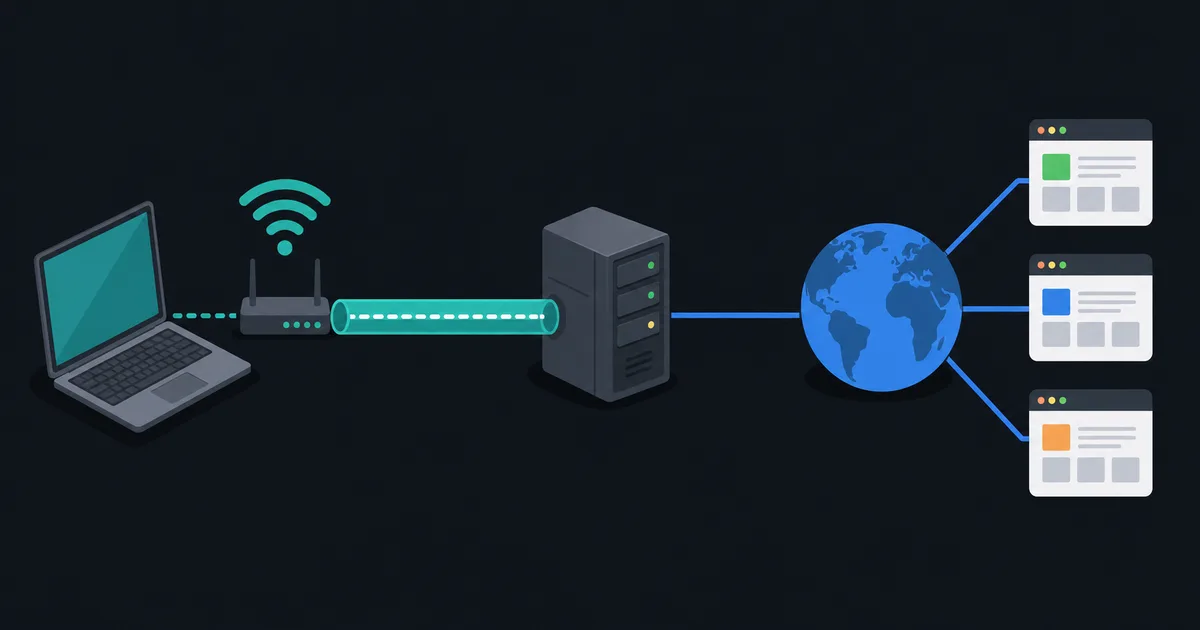
A VPN wraps traffic in additional headers for its tunnel, authentication, and encryption. Those headers use some of the space available on the physical path. A client or VPN service may therefore need to use a smaller tunnel MTU or maximum segment size than the local network's standard value.
This is normal overhead, not proof that a VPN is slow or broken. Correctly configured software accounts for it. Manually lowering MTU without knowing the path can also reduce efficiency, because more smaller packets are needed to transfer the same amount of data.
The useful question is not “what is the best MTU for everyone?” It is “what size works reliably on this interface and route?” That answer can change when you switch Wi-Fi networks, mobile networks, VPN endpoints, or destinations.
Symptoms that may point to an MTU issue
MTU trouble can look inconsistent. Small web pages might load while file uploads, video calls, a particular secure site, or a VPN connection hangs. A TCP connection can establish successfully before larger packets trigger the issue. These symptoms overlap with many other problems, including packet loss, server faults, and filtering.
Safe troubleshooting starts by comparing behavior with and without a tunnel, on a different network, and with more than one destination. Operating systems and network tools can perform path-MTU-aware tests, but exact commands and permissions vary. Do not permanently change a router or VPN setting based on a single failed test.
MTU is not a speed setting
Larger packets can reduce header overhead, while smaller packets may fit more constrained paths. Neither extreme is automatically faster. Applications and operating systems commonly use PMTUD, TCP maximum segment size negotiation, and protocol-specific recovery to make reasonable choices.
If a connection has persistent loss or congestion, changing MTU may hide the symptom without fixing the cause. Likewise, an MTU mismatch is not automatically a privacy issue. It is a packet-sizing and reachability issue.
The takeaway
MTU is the largest packet size a link can carry; path MTU is the smallest usable limit across an entire route. Encapsulation, including VPN tunneling, reduces available room. Reliable systems discover and respect that limit instead of treating 1500 as a universal answer.