The short answer
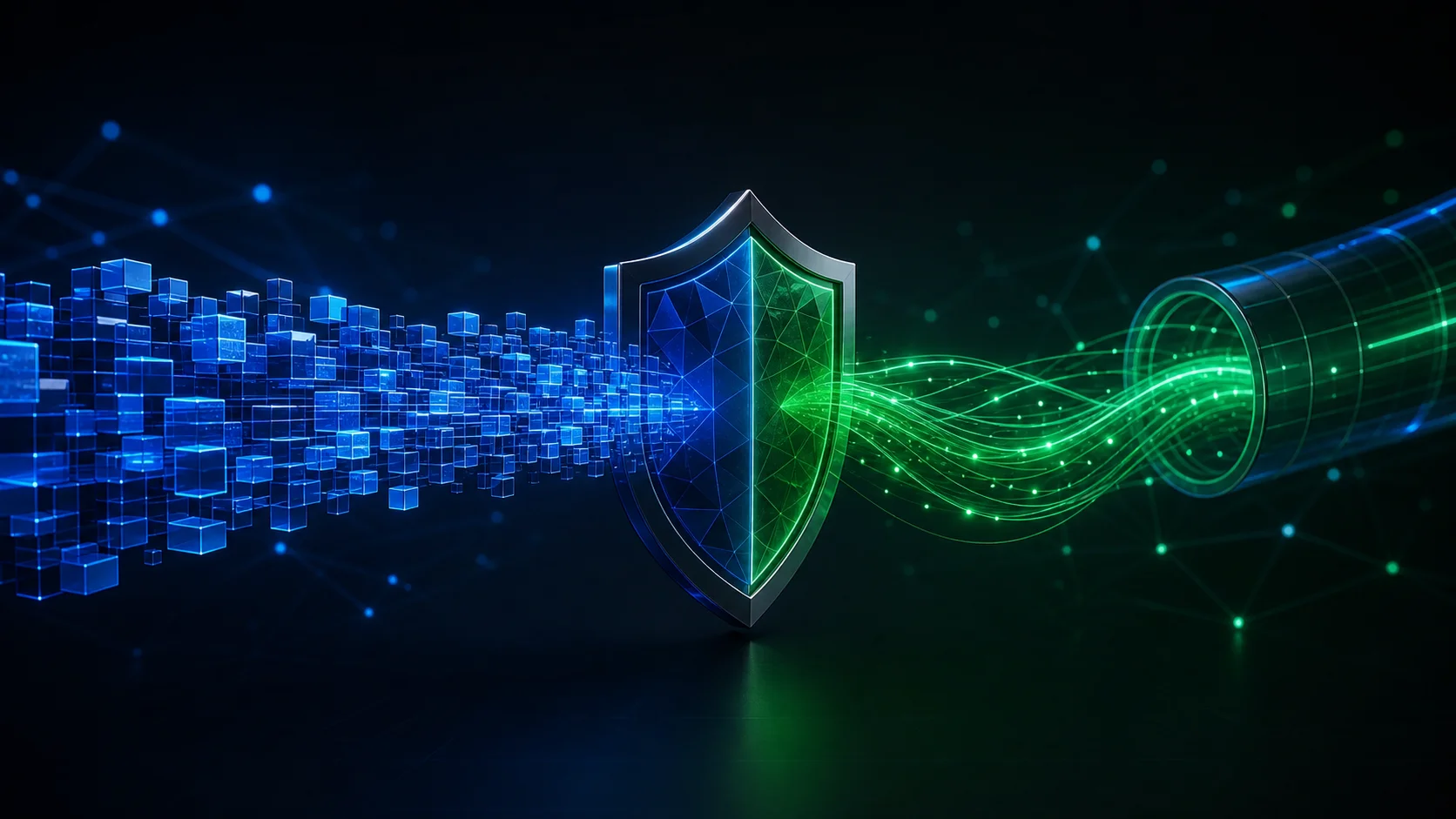
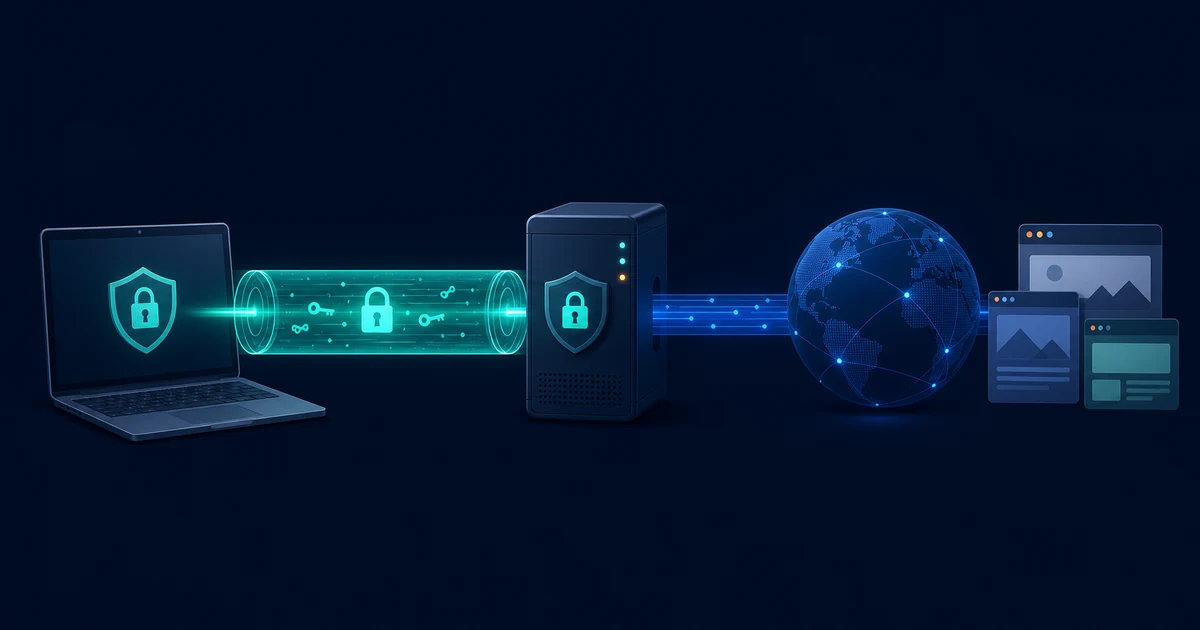
VPN encryption protects traffic between your device and a VPN server. Before ordinary data is sent, the VPN client and server authenticate each other and negotiate temporary session keys. The client then wraps selected network traffic in an encrypted tunnel, and the server unwraps it before forwarding the traffic to its destination.
That process gives a local network and your internet provider less visibility into the destinations carried through the tunnel. It does not make every part of a connection secret. The VPN provider operates one end of the tunnel, websites still receive application-level information, and HTTPS remains important for end-to-end protection.
Encryption is only one part of VPN security
People often use “encryption” as shorthand for the whole VPN security design. A working VPN normally combines several protections:
- Confidentiality makes the protected payload difficult for an observer to read.
- Authentication helps the client and server verify which peer they are talking to.
- Integrity lets the receiver reject data that was changed in transit.
- Replay and ordering protections help prevent an attacker from reusing or rearranging old packets.
- Routing rules decide which traffic is placed inside the tunnel at all.
Encryption alone does not prove who created a message or whether it was modified. A VPN needs authentication and integrity checks as well as a cipher. Modern authenticated-encryption designs combine confidentiality and integrity in a single data-protection operation.
What happens during the VPN handshake?
The handshake is the setup conversation that happens before a VPN can protect ordinary traffic. The exact messages differ between IPsec/IKE, OpenVPN, WireGuard, and other protocols, but the goals are similar.
First, the client learns enough about the server to authenticate it according to the configuration. Depending on the protocol, that may involve certificates, pre-shared keys, public keys, usernames, or a combination of these. The client also presents the credentials or key material required by the service.
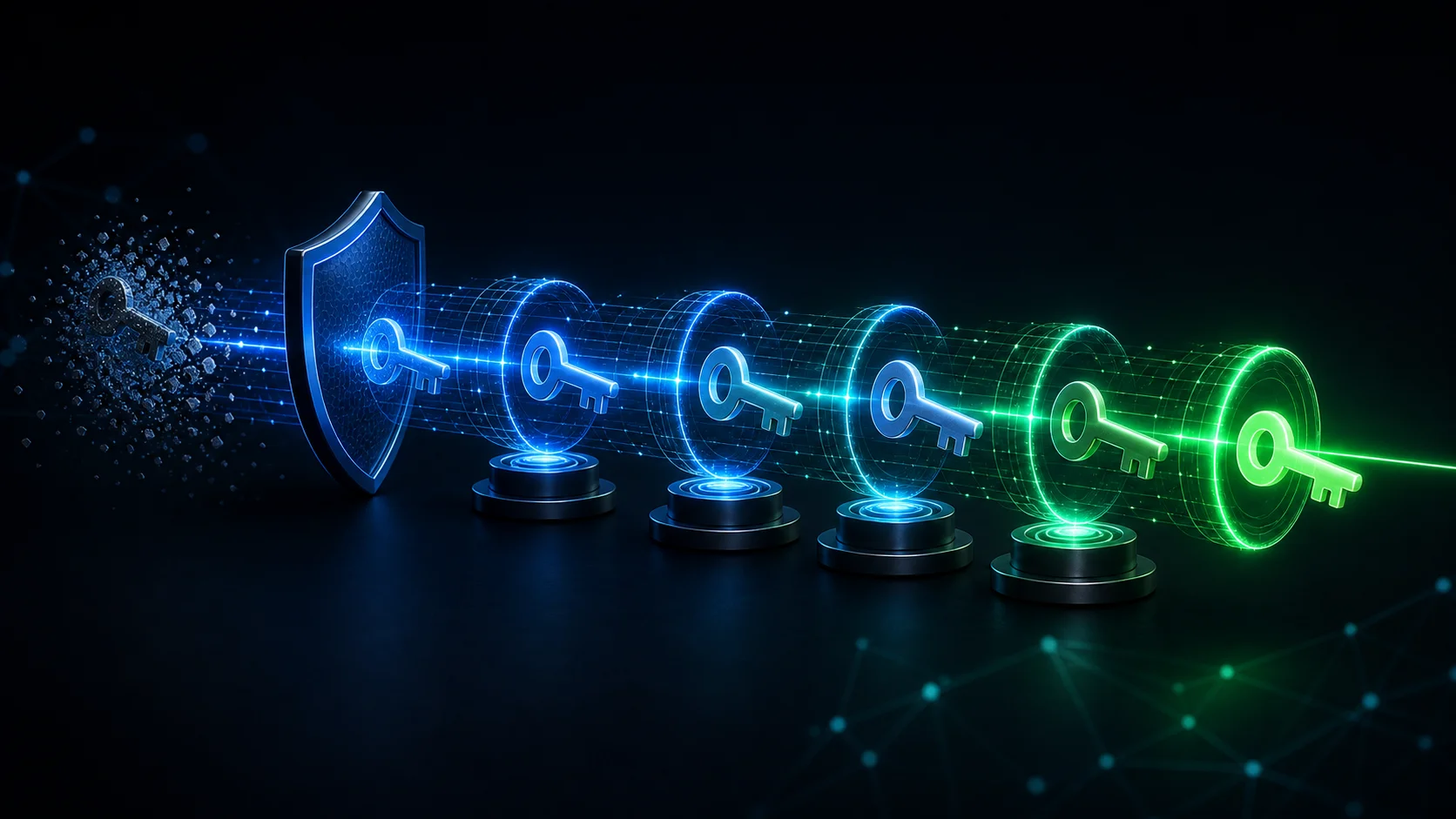
Next, the peers perform a key exchange. The exchange creates shared secrets without sending the final data-encryption key as readable text across the network. Key-derivation functions turn those secrets into traffic keys and other values used by the data channel.
For example, WireGuard uses a small authenticated handshake and then creates symmetric session keys for data transfer. IPsec commonly uses IKE to negotiate security associations and cryptographic parameters. OpenVPN uses a TLS-based control channel to authenticate peers and establish the material needed for its data channel. These protocols are different implementations of the same broad idea: authenticate the connection, agree on safe parameters, and derive keys for the traffic that follows.
How session keys protect packets
Once the handshake succeeds, bulk traffic is normally protected with symmetric cryptography. Symmetric algorithms use related secret material to encrypt and decrypt data efficiently, which is important when a VPN is carrying every packet from a phone or computer.
Modern VPN data channels commonly use authenticated encryption with associated data, or AEAD. AEAD protects the packet contents while also authenticating selected associated information, such as parts of a packet header. If the authentication check fails, the receiver discards the packet instead of handing altered data to the application.
Each protected packet also needs a nonce or sequence-related value that is not reused incorrectly with the same key. Protocols manage these values and rotate keys according to their own rules. Rekeying limits how much traffic is protected by one key and reduces the impact of a long-lived session.
What the tunnel looks like on the network
It helps to picture two packets: the original inner packet and the outer packet that carries it.
- An application creates an ordinary IP packet for its destination.
- The VPN client applies the routing rules and encrypts the selected packet.
- The client adds an outer header addressed to the VPN server.
- The local network carries that outer packet to the server.
- The VPN server verifies and decrypts the inner packet, then forwards it onward.
- Replies follow the reverse process and arrive back through the tunnel.
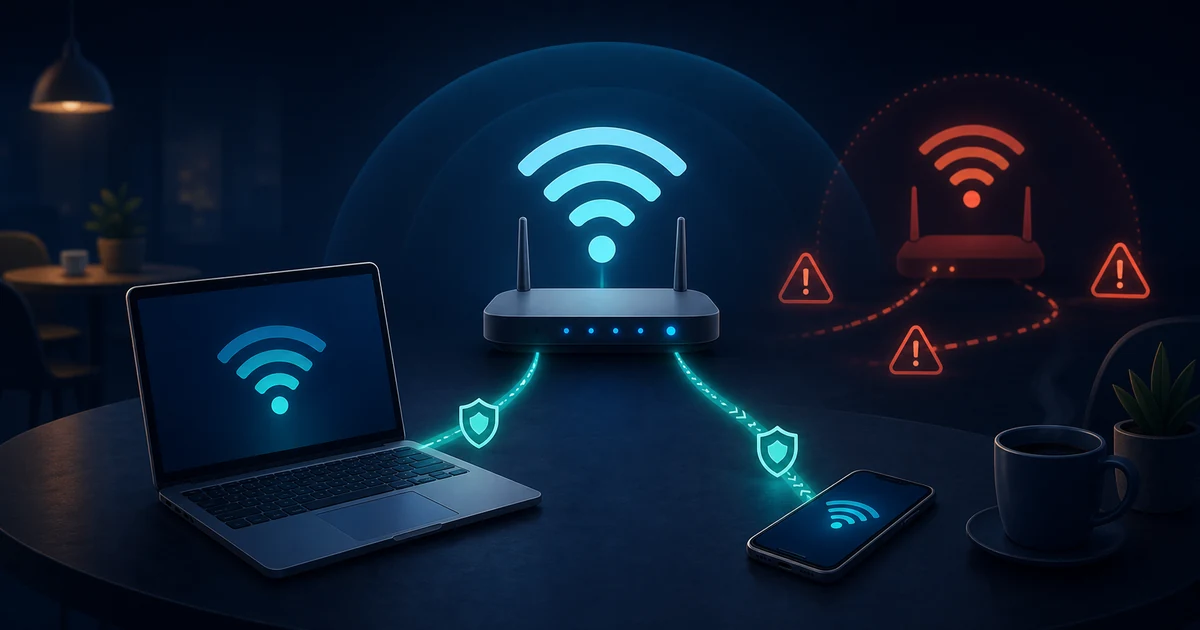
An observer on the local Wi-Fi network can usually see that the device is communicating with a VPN endpoint. It may also observe timing, volume, packet sizes, and some outer transport information. It should not be able to read the protected inner payload when the protocol and configuration are working as intended.
At the VPN server, the tunnel is decrypted before the onward connection is made. That is why a VPN changes which organization is in the middle of the connection; it does not remove the need to trust an intermediary.
AES-256, ChaCha20, and the protocol around them
AES-256 and ChaCha20 are names of cryptographic primitives, not complete VPN security guarantees. A VPN also depends on how keys are exchanged, how peers are authenticated, how nonces are managed, how packets are routed, and how the client handles failures.
AES can perform especially well when a device has hardware acceleration. ChaCha20-Poly1305 is designed to be efficient in software and is widely used by modern protocols, including WireGuard. The best choice depends on the protocol, implementation, device, and configuration. A larger number in a cipher name does not automatically make one VPN safer than another.
For a practical comparison, see AES-256 vs ChaCha20, WireGuard vs OpenVPN, and IKEv2 vs WireGuard.
Why perfect forward secrecy matters
Perfect forward secrecy, or PFS, uses temporary session key material so that a later compromise of a long-term identity key does not automatically reveal previously captured sessions. It is a property of the key-exchange design and key lifecycle, not a synonym for “strong encryption.”
PFS cannot undo a compromise of an endpoint while a session is active, and it does not protect data that an authorized endpoint has already exposed. It is one layer in a larger design. Read What Is Perfect Forward Secrecy? for the distinction between identity keys and per-session keys.
What VPN encryption does not hide
VPN encryption has a defined boundary:
- It does not hide traffic from the VPN provider in the same way it hides traffic from the local network.
- It does not remove cookies, account identifiers, browser fingerprints, or other website-level signals.
- It does not make an unsafe HTTP connection equivalent to HTTPS from the VPN server to the website.
- It does not protect traffic that bypasses the tunnel through split tunneling, a DNS leak, an IPv6 path, or a misconfigured application.
- It does not prevent malware, phishing, weak passwords, or an already-compromised device.
The tunnel is also only as complete as its routing configuration. What Is a VPN and How Does It Actually Work? explains the broader connection path, while What Is IPv4 vs IPv6? covers why both address families need attention.
How to evaluate a VPN’s encryption claims
Look for specific, testable information rather than a promise of total invisibility. A useful evaluation asks:
- Which protocols and cryptographic constructions are supported?
- How are the server and client authenticated?
- Does the software handle DNS and IPv6 consistently with the selected routing mode?
- What happens if the tunnel drops, and is a kill switch available?
- Are the clients maintained, documented, and independently reviewed where appropriate?
- What connection and account information does the provider say it processes?
Encryption protects a path; it does not settle every privacy question around the service. The strongest setup combines a well-designed protocol with current software, HTTPS, careful routing, and realistic expectations.
The takeaway
VPN encryption is a layered process: authenticate the peers, derive temporary session keys, protect packets with confidentiality and integrity, and route the selected traffic through the tunnel. The result can reduce what a local network or ISP learns, but the VPN provider, destination services, and endpoint still matter.