The short answer
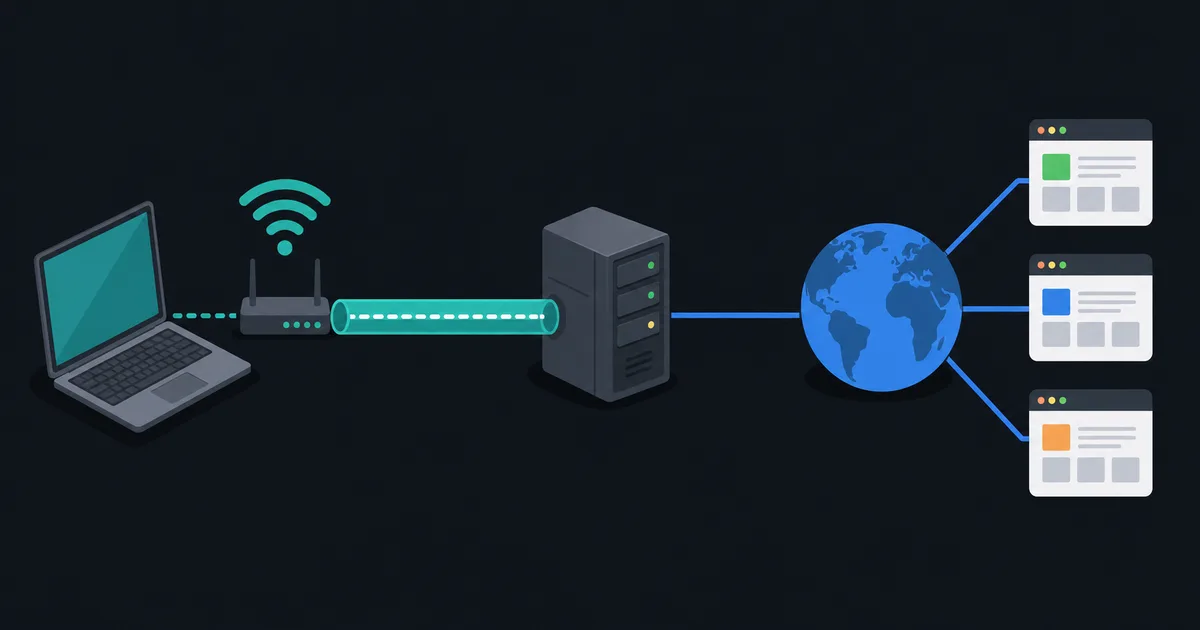
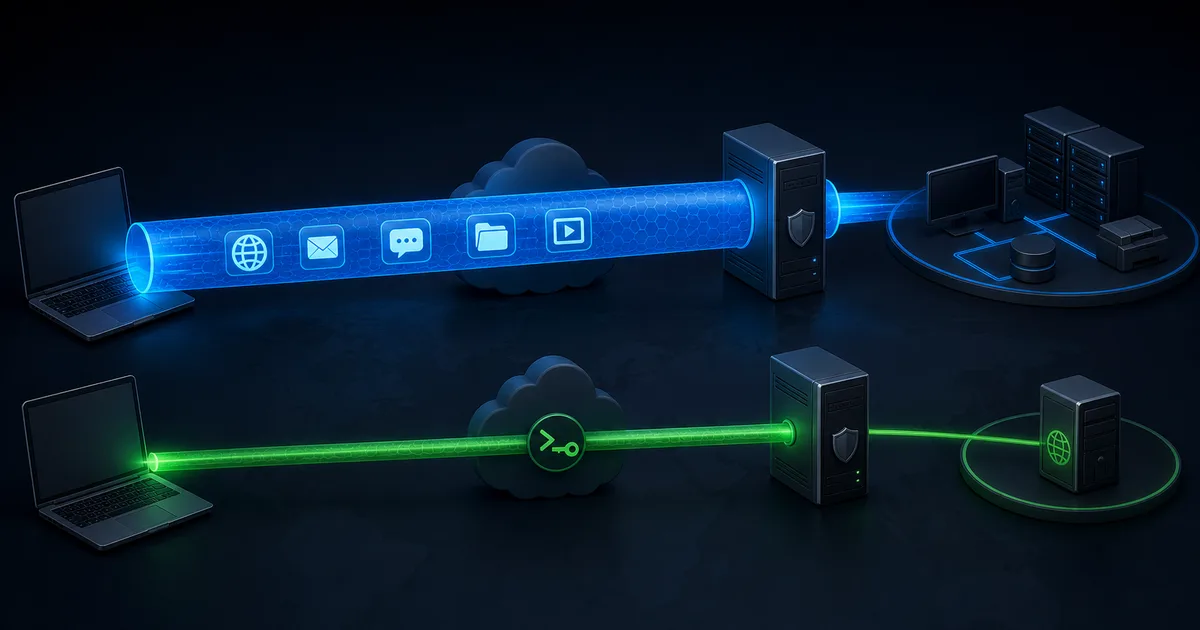
A VPN creates a network tunnel that can route selected IP traffic between your device and a VPN server or private network. An SSH tunnel forwards particular connections through an encrypted Secure Shell session. Both protect traffic on the segment between your device and the server, but they solve different problems.
Use a VPN when a device or network needs routed access to many services. Use SSH forwarding when an administrator or developer needs controlled access to a specific TCP service through a host they can log in to. An SSH tunnel is not automatically a full-device VPN.
The core difference: routes versus forwarded connections
A VPN client establishes a virtual network interface and applies routes. The configuration may send all internet traffic through the tunnel, only private subnets, or a deliberately selected set of destinations. A VPN server can then forward traffic to the internet or to resources behind it.
SSH forwarding opens channels inside an existing SSH connection. A local port on your machine, a port on the remote machine, or an application using a SOCKS-style dynamic forward becomes the entry point for a connection. Only applications that use that forwarded port—or traffic explicitly configured for the dynamic proxy—take the SSH path.
This narrow scope is often safer and easier to audit for one administration task. It is not suitable when an unmanaged app, all DNS queries, or an entire device must reach a private network.
Local, remote, and dynamic forwarding
SSH supports several useful patterns:
- Local forwarding makes a local port connect through SSH to a service reachable from the SSH server. It is common for accessing an internal database or web console without exposing it publicly.
- Remote forwarding makes a port on the SSH server forward back to a service reachable from the SSH client. It can help a remote machine reach a temporary local service, subject to server policy.
- Dynamic forwarding provides a local SOCKS proxy. Applications configured to use it can send TCP connections through the SSH server.
Each pattern has different exposure risks. Bind forwarded ports to loopback by default unless public or LAN access is deliberately required. Confirm server-side sshd policy, user permissions, and firewall rules before relying on a forward.
Encryption, authentication, and trust
SSH provides encryption, integrity protection, and server authentication for the SSH connection. User authentication commonly uses public keys, passwords, or hardware-backed methods. Always verify a server host key on first connection through a trusted channel and investigate unexpected key changes; accepting a changed key blindly defeats an important protection.
A VPN also uses authentication and encrypted tunneling, but its client and server manage routes as well as cryptographic sessions. In either case, the server is a trust boundary. It can receive forwarded traffic and can usually reach the intended destination on your behalf. The end service should still use its own encryption where available, especially for web and database protocols.
DNS and application coverage
A VPN can configure DNS behavior alongside routes. Whether it does so correctly depends on its configuration: split tunnels, IPv6, and internal domain names need deliberate handling. What Is DNS? explains why name resolution is part of the connection path.
SSH local forwarding targets a chosen hostname or address from the server's perspective. Dynamic forwarding only affects applications configured to use its SOCKS endpoint, and DNS may still happen locally unless the application is configured to proxy name resolution. Treat that distinction as an operational requirement, not a privacy footnote.
Performance and protocol constraints
SSH typically runs over TCP. Forwarding a TCP-based application through SSH therefore places that application's bytes inside one long-lived TCP connection. This is usually fine for interactive administration, but it can behave poorly on lossy links when multiple streams compete for recovery in the outer connection.
VPN protocols vary: some use UDP and some use TCP. Their performance depends on routing, packet loss, congestion, encryption overhead, and the application, not merely on the word "tunnel." TCP vs UDP Explained Simply covers those transport differences.
Practical choices
Choose SSH forwarding for a short-lived, least-privilege path to a known service, especially when you already manage a hardened bastion host. Keep the server patched, disable password authentication where appropriate, use strong keys, restrict forwarding privileges, and close unused tunnels.
Choose a VPN for stable private-network access, employee devices that need several internal services, or a defined set of traffic routes. A VPN client can also be more suitable when services depend on private DNS, multiple ports, UDP, discovery, or device-wide policy. For consumer internet privacy, see What Is a VPN and How Does It Actually Work?.
Operational safeguards for SSH forwarding
SSH forwarding should be treated as access to the destination service, not as a harmless local convenience. Use separate user accounts and keys where practical, protect private keys with a passphrase or hardware-backed authenticator, and remove keys that are no longer needed. On shared or production hosts, restrict which users may forward ports and which destinations they may reach.
Avoid binding a local forward to every network interface unless another device genuinely needs it. A forward bound to 127.0.0.1 is reachable only on the local machine; a broadly bound port can unintentionally expose an internal service to a nearby network. Likewise, remote forwarding may be restricted by the SSH server because allowing arbitrary public listeners can expose services unexpectedly.
For ongoing access, document the tunnel's owner, destination, port, authentication method, and expiry. A formal VPN or a purpose-built access gateway is usually easier to monitor and revoke when many people, devices, or services need access. SSH remains a strong tool when its scope stays small and intentional.
A simple decision rule
If you can name one service and one SSH-accessible host, start by considering a local SSH forward with the narrowest allowed bind address. If the requirement instead says "this device needs the private network," "several applications must work," or "internal names must resolve normally," use a properly managed VPN. This rule is not about which protocol is more secure; it is about choosing a scope that matches the job.
Do not convert a narrowly scoped SSH solution into a pseudo-VPN by adding unmanaged forwards one at a time. That becomes difficult to audit, does not necessarily support UDP or discovery traffic, and can leave DNS behavior ambiguous. Move to a documented network-access design when the requirement grows.
The takeaway
VPNs and SSH tunnels both encrypt a path to an intermediary, but a VPN routes network traffic while SSH forwarding carries explicitly selected connections. SSH is excellent for targeted remote administration; it is not a substitute for a properly configured VPN when broad network access, DNS integration, or device-wide routing is required.